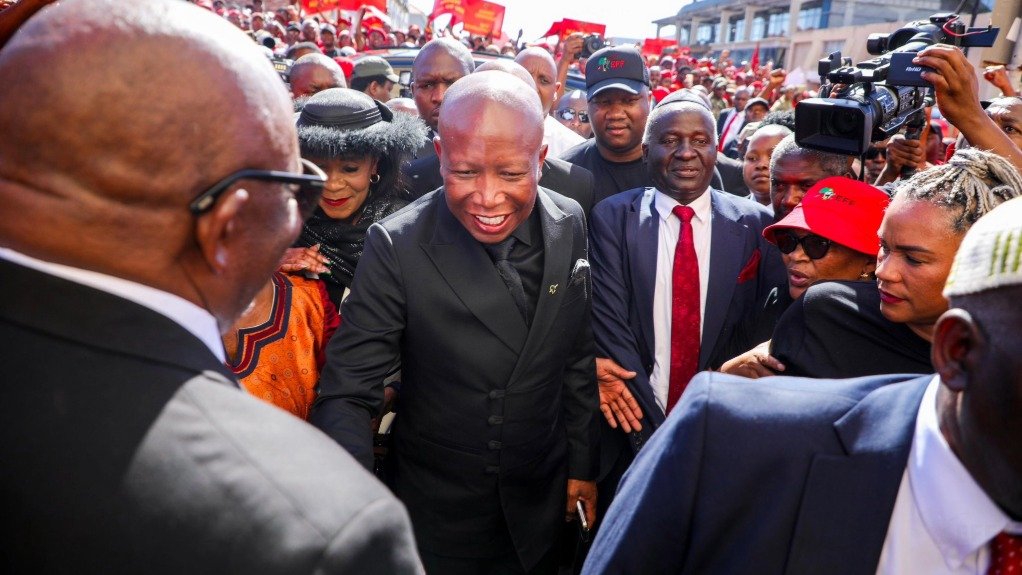
J ulius Malema, the EFF President and Commander-in-Chief, arrived at court accompanied by members of the Moshabi clan and senior party officials. Addressing supporters outside the court, Malema framed the proceedings as part of a broader political struggle.
“Our living ancestors are here with us today to show support for their son, whose only crime is his love for Black people,” Malema said.
Tight security measures were implemented, and court proceedings were briefly disrupted as EFF supporters attempted to force their way into the magistrate’s court building. Video footage circulating online showed heightened tensions outside the venue as police sought to control the crowds.
Malema was convicted in October 2025 on five counts stemming from a 2018 EFF rally, where he was found guilty of unlawfully possessing a firearm and ammunition, discharging a firearm in public, and reckless endangerment. The incident involved Malema firing a rifle into the air during the rally.
During the pre-sentencing hearing, the defence argued for a non-custodial sentence, citing Malema’s family responsibilities, political leadership role, and willingness to perform community service. Prosecutors, however, pushed for a direct prison sentence, arguing that Malema had shown no remorse and that the offences were serious enough to warrant incarceration.
The National Prosecuting Authority indicated that Malema could face a prison sentence of up to 15 years. A custodial sentence exceeding 12 months without the option of a fine could result in Malema being barred from serving in Parliament for five years.
The court ultimately postponed the pre-sentencing proceedings to 15 April 2026, meaning Malema had not yet been sentenced as of 24 January 2026. His legal team confirmed that he intended to appeal the conviction.
Following the court appearance, the EFF held a press briefing where Malema struck a defiant tone, saying he did not fear imprisonment or death.
“Prison and death are part of the struggle,” Malema said. “The real threats facing our people are poverty, unemployment, landlessness, and the loss of dignity. This fight is about freedom.”
Despite the legal uncertainty, Malema vowed to remain the voice of the oppressed, telling supporters that the outcome of the case would not deter the EFF from pursuing its political objectives.
The postponement of the case ensured that the spotlight on Malema’s legal battle would continue in the months ahead, as the country awaited a sentencing decision that could have far-reaching consequences for one of South Africa’s most polarising political figures.
Comments
Leave a Comment
No comments yet. Be the first to share your thoughts!