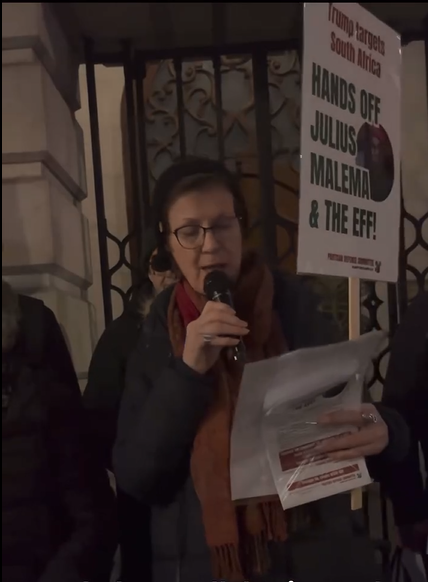
A ddressing the crowd, McColgan framed the protest as more than a show of solidarity with Malema. She argued it was a confrontation with Britain’s own imperial legacy and present-day economic interests in South Africa. Britain, she said, remains one of the country’s largest foreign investors, with influence “entrenched in the economy and political life of the country.” From this perspective, criticism and legal pressure directed at the EFF were portrayed not as isolated events, but as part of a broader effort to contain movements that challenge capitalist structures.
The protest drew attention to how South African politics reverberate far beyond its borders. Placards and chants linked the EFF’s calls for land redistribution and economic transformation to wider anti-imperialist struggles, a theme that has become increasingly prominent in London’s left-wing protest scene since the outbreak of multiple international conflicts. McColgan told supporters that defending Malema was “inseparable from building militant, anti-imperialist resistance at home and internationally,” a line that drew applause from the crowd.
McColgan is a familiar presence at such mobilisations. A vocal member of the Spartacist League, she regularly engages in ideological debates within the British left and trade-union milieu, including discussions around the Trade Unionist and Socialist Coalition (TUSC). Over the past year, she has also been involved in anti-genocide protests and organising activity outside London, including actions in Birmingham with groups such as Women of Resistance.
Her interventions and polemics frequently appear in Trotskyist publications, notably Workers Hammer, and her name has surfaced in early-2026 editions of the Weekly Worker amid debates over strategy and sharp criticisms exchanged among socialist organisations. On the streets, she has been active in counter-demonstrations against right-wing mobilisations, positioning the Spartacist League as an uncompromising opponent of nationalism and racism.
The London rally underscored how global flashpoints continue to animate Britain’s fragmented left. While the immediate focus was South Africa, the protest’s message was aimed just as much at Westminster and the City of London: a reminder, organisers insisted, that Britain’s imperial footprint remains a live political issue—and one they intend to keep contesting on the streets.
Comments
Leave a Comment
No comments yet. Be the first to share your thoughts!